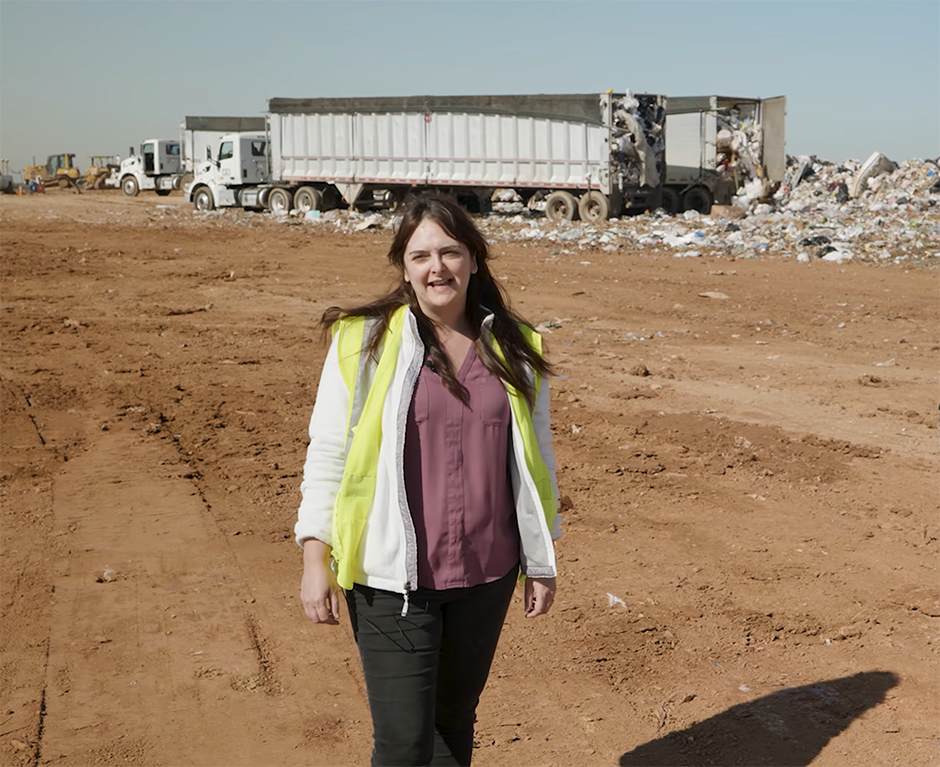
In this edition of our Solid Waste Outreach Team Spotlight, we’re getting to know Sara Davarbakhsh, an environmental education program coordinator and member of Wake County’s Solid Waste Outreach and Marketing Team. Sara leads the County’s compost bin sale, event recycling and bin loan program, and tours of the South Wake Landfill, where residents can see up close what happens to their trash and how the landfill is designed and operated.
Getting to know Sara
How long have you worked with Wake County and what made you interested in environmental education?
I have worked for Wake County for 17 years. I have been interested in environmental science and environmental engineering since I was a teenager because it included all my favorite subjects in school (STEM). I also wanted to pursue a career that made a difference in my community, and growing up in the ’90s, I realized the environment was going to be an important 21st-century issue.
What’s one thing you’ve been most proud of since you joined the Solid Waste Outreach Team?
Being nominated for and winning the 2023 N.C. Environmental Educator of the Year Award.
A closer look at the South Wake Landfill
How do you keep the landfill tours interesting after doing them for so long, especially for residents who have visited multiple times? What keeps it interesting for you?
When residents see the landfill firsthand and all the trash there, they often have an epiphany moment. As the saying goes, “seeing is believing.” There is nothing like seeing a giant mountain of garbage you know you helped make to motivate you to do better. Their “aha” moment is gratifying to be a part of.
And the landfill is always changing. It is a 25-plus-year construction project. What’s more, we utilize the most advanced landfilling technologies and talent at South Wake Landfill. I’m proud of the responsibility we take and the work we do. I continue to “geek out” at the modifications and improvements leadership makes.
What is your favorite way to start a conversation with people on a landfill tour?
I like to start with, “How many people have made trash today?” Eventually everyone puts their hands up. Then I ask, “How many people have visited a landfill before?” And all their hands go back down.
After trash day, most people never give their trash a second thought. The problem of what to do with their trash has gone away, but really there is no such thing as “away,” and at South Wake Landfill, we offer residents a unique opportunity to find out what happens when they throw something in the trash.
What is the funniest or most interesting question or comment you’ve heard while on a landfill tour?
The most interesting question would be, “Why are there so many birds at the landfill?” In the winter, we receive a migratory population of over 15,000 gulls from the Great Lakes. The reason is that nearly one-third of the trash in the landfill is food waste (29% in 2026).
The funniest question would be, “Why don’t we send our trash up into outer space and fire it into the sun?”
Recycling, composting and community education
Please share one of the most eye-opening or bizarre experiences you’ve had while working at a community event.
After talking about recycling to people at community festivals, I realized many rely on recycling as their only way to reduce waste, and for some people, when it doesn’t solve the problem entirely or they run into issues, they give up, putting everything in the trash. Recycling is one tool in the toolkit, a very effective tool at managing waste materials, but it cannot solve the entire waste issue, and part of my role is to provide realistic expectations.
However, the idea that recycling isn’t a better option than disposal is bizarre to me. Some articles people send me in the mainstream news claim “recycling is a hoax.” These articles often fail to consider the bigger picture, which is misleading and ends up doing more harm.
The role of an environmental educator is to give people all the facts and let them make up their own minds. In Wake County, recycling is a localized service; it has not been standardized yet, but there are far more similarities than there are differences. There are also more benefits than most realize, not just environmental, but economic and social, too. With more education, we can do a better job of getting the facts out there.
What is one of the biggest challenges you hear from people about composting, and how do you advise them to overcome it?
People new to composting often add too many food scraps, and the scraps will not break down fast enough, which can lead to odors. But if they add the other vital ingredients too, it should never smell. Odors can easily be fixed by rebalancing your pile.
What is one of the most fascinating composting facts you like to share at events?
Composting is a bit like baking a cake. There is a basic recipe to follow, and it does involve science, but there is as much of an art to it, too. There are just four ingredients to balance (bring together in the right amounts). If you stray from the recipe, it can go askew, but if you follow the recipe, anyone can do it and master it in no time.
Inspiring a more sustainable Wake County
What keeps you excited about talking about trash?
Most people do not realize how much potential trash has. Everything we use and throw away is a resource and has more possibilities. I would like people to open their minds to how they view trash. Just because something no longer has use or value to them doesn’t mean it’s useless. Additionally, waste is connected to so many different facets of societal life and is one aspect all humans have in common.
Solid Waste events sometimes have special visits from the recycling mascot Paper Guy. If he could explain a fun fact about waste reduction, what do you think he would tell someone who has never composted or recycled before?
Wake County has some award-winning programs to help schools recycle and compost their waste. Paper Guy and his crew of environmental educators are here to help. Learn more and reach out at wake.gov/recycling.